

Showing posts with label sustainable design. Show all posts
Showing posts with label sustainable design. Show all posts
Friday, February 24, 2012
Co-design is a key example of citizen design in a TED talk
Jess McMullin gives a TED talk on the importance of citizen participation in design - especially for public space. The VIVA Vancouver Co-design street party is a key example of recording desired experiences as a starting point of design. Furthermore, we engaged the public where they are: on the street.


Tuesday, October 11, 2011
From co-design to breaking ground: Project BUG work party
 |
| photo credits: Ian Marcuse |

"When commenting on their experience, students highlighted that they enjoyed the drawing out or “co-designing” of the project, helping with the design, and in particular “the collaborative effort with members of the community and other students within their community schools”. For students, the planning process was one of “creation of the gardens, just watching them come to life”, which leads directly into the hopes and aspirations these students have for the garden in the future. There was a resounding hope from students that they can see this garden to completion in the near future."
Project BUG final report , prepared by Ian Marcuse, Grandview Woodland Food Connection
Zsuzsi Fodor and Erica Lay, UBC School of Community and Regional Planning June, 2011

Friday, August 5, 2011
Little Mountain Co-design Video
This video is great for describing the philosophy and rationale of co-design. A 20 minute video of the Little Mountain co-design, facilitated by The Co-Design Group. Co-design images are created by citizens and therefore, the citizens feel a great sense of ownership of the drawings. The artist is only the hand for the mind's eye. When the drawings are done, the design team analyzes and prioritizes all ideas to create a design solution from the complex and rich compilation of vignettes. This co-design workshop was the start of an extensive consultation process. A summary of their concepts can be found here.
Little Mountain Redevelopment: Meeting #1 The Stanley King Experience from David Vaisbord on Vimeo.
Little Mountain Redevelopment: Meeting #1 The Stanley King Experience from David Vaisbord on Vimeo.
Wednesday, July 20, 2011
Co-design Demo at the Viva Vancouver Street Party
There will be Brazilian martial arts, dance food and... co-design! Click on the image below to get the schedule. photos of event here.
Thursday, June 23, 2011
Early work, 1970s
Some photos of early co-design work pioneered by Stanley King. In this case, the site was a huge parking lot in downtown Vancouver. Stanley organized a "City on the Wall" and also a "Design- in". During the site walk, teens analyzed the car lot for sight, smell, sound, movement and circulation. The resulting drawings illustrated public desire for activities supported by abundant green space, a dome with a skating rink, outdoor eating, water features.
People asked for car-free pedestrian spaces for relaxing, socializing, eating. The ideas, drawn from ordinary citizens, demonstrate how co-design can sensitively tap into citizen's desires for how they wish to live. Drawings were given to the design team led by Arthur Erickson who designed Robson Square. Erickson asked Cornelia Oberlander to design the landscape: the first roof garden in North America.
These still shots are from Chairs for Lovers, a documentary film directed by Barrie Howells for the National Film Board of Canada.
 |
| Robson Square Before |
 | ||||
Robson Square (after) designed by Arthur Erickson
|


 |
| Stanley King starting the "city on the wall": "imagine you were here when the land was new...." |
 |
| Stanley encourages kids to draw anything they want in a city |
Sunday, May 29, 2011
Sustainable VSB Show and Tell
Vancouver School Board: Sustainability from Josli Rockafella on Vimeo.

 |
| Kevin outlines the VSB sustainability framework an invites response |

Kevin Millsip, district sustainability coordinator for Vancouver School Board, hosted a VSB Sustainability Show and Tell to engage staff to respond to the VSB sustainability framework. Next Up youth leaders led a world cafe dialogue. I facilitated a co-design timeline as a grafitti wall: A Day in the Life of a Sustainable VSB. Kevin asked for youth input during the Plan-It Earth conference.

Monday, April 25, 2011
Plan-It Earth, planned by youth for youth

We are very grateful for support from Bruce Ford and Vanessa Lee (Metro Vancouver); from Amanda Mitchell (the City of Vancouver); from Kevin Millsip, (sustainability coordinator, VSB) and Stanley King from the Co-Design Group who donated facilitation services. We accepted funding, with thanks from Architecture Canada: The Royal Architectural Institute of Canada, the Vancouver Foundation Youth Philanthropy Council, and the Vancouver School Board through Kevin Millsip's project eco-logo contest.
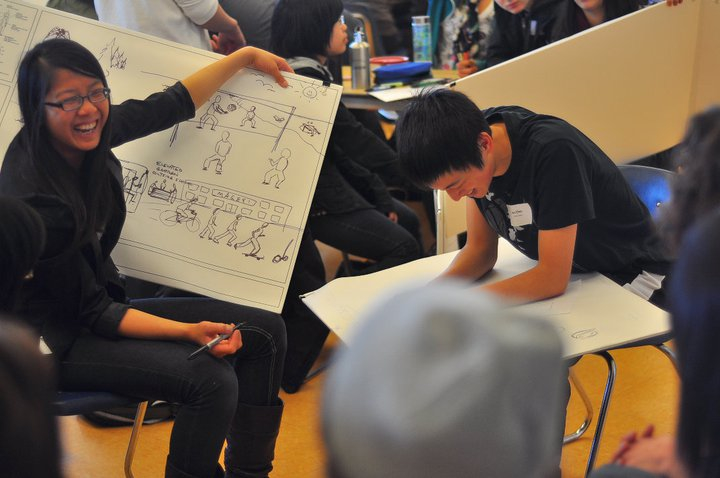 |
| Tesicca, youth co-design artist, plan-it earth core team |
 | ||
day in the life of a sustainable region
 |

Bridging the generation Gap
North shore news featured youth co-design in West Vancouver:
"Through outreach, the co-design process adopted by Grosvenor attempts to bring in voices from different demographics, says Michael Mortensen, Grosvenor Americas’s senior development manager. It’s a unique opportunity for youth to be involved in a process that usually takes place among adults. Co-design forums were pioneered by Vancouver architect Stanley King, who is leading the Ambleside forums. He created the concept while working on Granville Island and Robson Square.
"Through outreach, the co-design process adopted by Grosvenor attempts to bring in voices from different demographics, says Michael Mortensen, Grosvenor Americas’s senior development manager. It’s a unique opportunity for youth to be involved in a process that usually takes place among adults. Co-design forums were pioneered by Vancouver architect Stanley King, who is leading the Ambleside forums. He created the concept while working on Granville Island and Robson Square.
In the end, the youths’ ideas became a big part of Vancouver’s identity. It was their suggestion to place a skating rink in Robson Square; famous West Vancouver architect Arthur Erickson was inspired by their sketches filled with greenery when designing the provincial courts."
Full article here: "Bridging the Generation Gap" by Rebecca Aldrous, North Shore outook
Saturday, March 26, 2011
conversation with Cornelia Oberlander

Visited Cornelia Oberlander, the "Grande Dame" of Canadian landscape architecture. She'd been helping out at my school and wanted to catch up on a garden project. Cornelia has a reputation for being charming, gracious and immovably persistent. These traits are useful: she sometimes faced bureacratic hurdles as a pioneer of sustainable landscape architecture. There is a bit of the rebel in Cornelia that helps her to connect with youth and we were very grateful to have her come and speak to youth at the Sustainable Design Ideas Fair.
Thinking about David Owen's Lecture, I asked Cornelia about her thoughts on dense urban centres and biodiversity: "Is it possible to merge density with ecological design?"
Monday, March 21, 2011
thoughts on David Owen's Lecture: Why Manhattan is the Greenest City in North America

Co-design attended David Owen's lecture in Vancouver. A summary of Owen's ideas can be found in his blog here, and in the New Yorker article here. Owen argues that dense urban centres are an effective alternative to sprawl for preserving farmland and ecological habitats. And "living smaller, closer, driving less" reduces our carbon footprint. While this is true, I'm not convinced that density on the scale of NYC is a green solution.

If high-density urban centres preserve earth's wilderness and farmland by virtue of avoidance, then this solution might be even more green than NYC:
 |
| Moon base Alpha |

Density is an efficient solution but is it ecological? Ecological systems are self supporting. Take into consideration the following factors: living plants and animals forming the food source, waste absorbed by the landscape; inhabitant's psychological need for light and green space... If we now draw a radius from NYC , what would be the extent of the circle?
Monday, March 14, 2011
Training youth co-design artists for Plan-it Earth

Youth from five different Vancouver Schools are training to be co-design artists for the Plan-it Earth conference on April 15th. Planned by youth, for youth, registration started last week. Today's training session was at Granville Island. They learned: how to draw people in a one and two point perspective; marker techniques on vellum paper; and how to draw foliage quickly. First steps in learning co-design dialogue techniques from Stanley King.
 |
| Stanley knows the art of gentle crit |
Monday, February 21, 2011
Project BUG next step

Project BUG, organized by Grandview Woodland Food Connection moved into the next design stage today. Flickr set of photos here. Students examined the data gathered from the community input. All the co-design drawings were rated by the community: Students, parents, teachers and community members had an opportunity to vote on their desired features. Erin, from SCARP, facilitated a session where groups of students walked through the site and marked their ideas on a plan. The purpose of the session was to synthesize all the ideas into a plan for the three garden sites. Dolores Altin, a landscape architect from Evergreen Learning Grounds, gave students a presentation on food security and garden design. She showed examples of school food gardens in BC, and emphasized that design of a space is an on-going process. Followup to this, (update, Oct 2011): The Build party occurred Fall of 2011
 |
| all the features of the drawing were rated "I love it, go for it", "needs more designing" or "this belongs elsewhere". Today, students considered the features that received a high rating from the community. |
 |
| Dolores discussing priorities for the design |
 |
| students learn strategies for overcoming bureaucratic hurdles |
 |
| Erin displaying the plan for the site |
 |
| Erin demonstrates a shadow study for the garden site |
 |
| Stanley facilitates discussion of design ideas in one group during the site walk: "Ask yourself what would you be doing here?" |
Tuesday, January 25, 2011
Project BUG
Grandview Woodland Food Connection asked Stanley and Susan to help facilitate a youth program in Vancouver. Using some of the techniques described in the Youth Manual, students shared their ideas for how they wish to experience a community garden on school grounds. Here is the flickr set of photos as well as the follow-up session here and, later a build party for the new student garden
 |
| Stanley is facilitating a drawing with youth participants |
 |
| Susan invites participants to create a city on the wall |
 |
| participants create a city out of wilderness |
 |
| Desired personal experience and perceptions noted on this drawing |
 |
| Day in the Life of the Garden, a graffiti wall. |
 |
| Susan draws youth harvesting mushrooms on a cob house, at the direction of the participants |
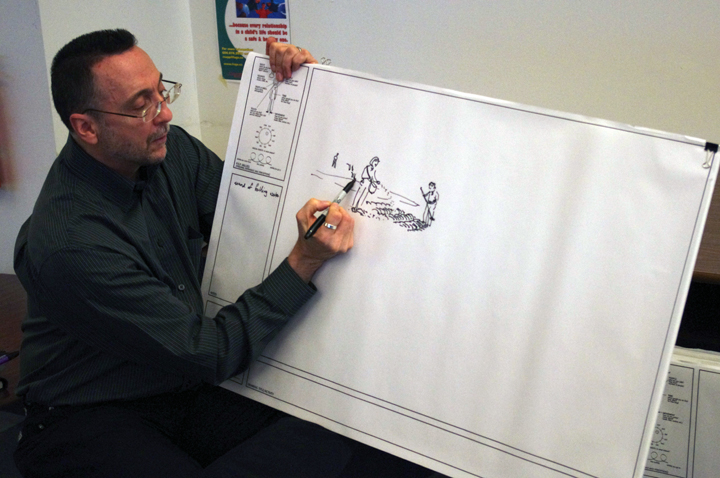 |
| Drew Ferrari facilitating a collaborative design dialogue. This sequence of drawings took less than an hour. activities and features are dictated precisely by participants. |


 |
| the collaborative drawing is now complete and features are numbered for voting |
Thursday, September 2, 2010
Why include youth in sustainable design?

If youth designed a city, what would it look like? More importantly, what would it be like to live there? Would they create places very different from our cities today? Our work with Vancouver youth reveals that a youth designed city would be green, full of light and life. Skateboarding, cycling and blading would be the wheels that rule the roads. Places for dancing, art, music, gathering, sports, napping would dot the urban landscape. School would take place outdoors. Youth have fresh eyes, new perspectives that are unencumbered by thoughts of mortgages and economics and politics (King, 1995). Paul Goodman said "No city is governable unless it grows citizens who feel it to be theirs".
Subscribe to:
Posts (Atom)