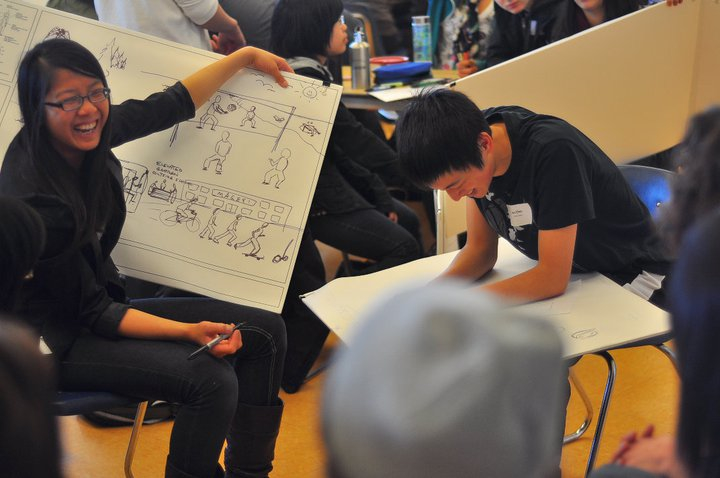
Susan, wilderness chick, enabled participants to learn 10 bog species in just 10 minutes, using silly memory tricks, one participant is being a little teapot and holding labrador tea.
Stanley, city dude, led a City on the Wall activity to demonstrate the effect of urbanization on a pristine wilderness setting
Beaty Biodiversity Museum had their Urban Festival today. Their flagship specimen is an enormous blue whale skeleton. Imagine your city respects biodiversity. What would you be doing? Families, teens, toddlers, and fellow Beaty volunteers co-designed "biodiverse-city". Two 17 year old visitors from Ontario expressed great concern for their ecological future. They were interested in biology, ecology and art. One drew a mermaid on the "Day in the Life" timeline. The conversation made me reflect on how a combination of passion, leadership, creativity and technical expertise will be required of youth to face challenges they never chose for themselves. They were fascinated by the museum, biodiversity and the challenge of designing a biodiverse-city.
I attended the lecture on Crowdsourced Cities conducted by SFU. Lukas Biewald of Crowdflower explained the background and trends in crowdsourcing, Darin Dinsmore of Crowdbrite showed how an international competition led to innovation in design., and Colleen Hardwick of PlaceSpeak demonstrated the use of pioneering software for location-based community consultation.
Each speaker spoke of their innovative use of the computer to reach people to collect many human judgements on planning issue. The large numbers of opinions, and the speedy gathering of them, were seen as advantages over traditional methods of public design dialogue.
200 people were in attendance at Plan -it Earth 2011 on April 15th. This event enabled 120 youth to draw, write and describe their sustainable region. Planned by a core group of five dedicated youth and an action team of about 30 students, all from Churchill, Prince of Wales, St. Pats and Kitsilano Secondaries. Participants came from throughout Vancouver, and we warmly welcomed the presence of Windermere Secondary and Magee Secondary youth leadership groups. Students from David Lloyd George Elementary attended the Children's program. Plan-it earth was a collaboration of Vancouver youth with a passion for the environment. This event was hosted once again by Prince of Wales Secondary. Thanks PW admin team!
North shore news featured youth co-design in West Vancouver:
"Through outreach, the co-design process adopted by Grosvenor attempts to bring in voices from different demographics, says Michael Mortensen, Grosvenor Americas’s senior development manager. It’s a unique opportunity for youth to be involved in a process that usually takes place among adults. Co-design forums were pioneered by Vancouver architect Stanley King, who is leading the Ambleside forums. He created the concept while working on Granville Island and Robson Square.
In the end, the youths’ ideas became a big part of Vancouver’s identity. It was their suggestion to place a skating rink in Robson Square; famous West Vancouver architect Arthur Erickson was inspired by their sketches filled with greenery when designing the provincial courts."
Co-design attended David Owen's lecture in Vancouver. A summary of Owen's ideas can be found in his blog here, and in the New Yorker article here. Owen argues that dense urban centres are an effective alternative to sprawl for preserving farmland and ecological habitats. And "living smaller, closer, driving less" reduces our carbon footprint. While this is true, I'm not convinced that density on the scale of NYC is a green solution.
If high-density urban centres preserve earth's wilderness and farmland by virtue of avoidance, then this solution might be even more green than NYC:
Moon base Alpha
Density is an efficient solution but is it ecological? Ecological systems are self supporting. Take into consideration the following factors: living plants and animals forming the food source, waste absorbed by the landscape; inhabitant's psychological need for light and green space... If we now draw a radius from NYC , what would be the extent of the circle?
This video summarizes a design event focused on co-designing the future of the Britannia Centre. Facilitated by Maged Sembel's classes from UBC's School of Community and Regional Planning. In part, it features the co-design work of Stanley King.
Note the richness of citizen ideas as partcipants express a desire for an integrated neighbourhood of diversity, creativity, and affordable living. Co-design images emerge showing pedestrian spaces for every age group, and activities relating to art, food security and community.
At the end of the video, a cameo of Ray Spaxman, former director of planning for the City of Vancouver, and a champion of "neighbourliness":
"Ray Spaxman was recruited as city planner by Vancouver's leadership in 1973, when the public was in full flight from the excesses of modernism and out-of-control development. Only a decade and a half previously, the tallest building in the West End was the Sylvia Hotel. ("Dine in the Sky" said the sign on the roof.) And not many people thought several hundred concrete slabs had really improved our urban ambience all that much.
Spaxman was responsible for changing the way planning and development was done in this city -- and he summed it up in one word: "neighbourliness." A building had to be respectful of its neighbours, and of the citizens on the street.
Buildings, in other words, had to be more than sculptural objects on vacant plazas -- "pigs in space," as some planners call them. It didn't matter how "iconic" a building was if it selfishly ignored the urban environment in which it dwelt."
Stanley attended the Jan Gehl lecture and found a great connection to co-design.
His theme was the long lack of human scale and life in the architectural and planning design processes, how architects since the 60’s have been anti-people (as a newly graduated architect he had to change because his girl friend, later his wife, was a psychologist and asked him, “Why do architects hate people?”) Planners, he said, have for years been sweet on the car and now must be sweet on people, and particularly, sweet on cyclists.
He said they now have a problem of bicycle congestion in Copenhagen and must push bike-lanes into more car-lanes. Research shows that for every kilometre bicycled the city gains 25c, and for every kilometre car travelled the city loses 10c. And when New York Times Square went pedestrian the merchants around increased turn-over by 71%. Great stuff. - Stan
See a video of Jan Gehl here: select the photo below:
Grandview Woodland Food Connection asked Stanley and Susan to help facilitate a youth program in Vancouver. Using some of the techniques described in the Youth Manual, students shared their ideas for how they wish to experience a community garden on school grounds. Here is the flickr set of photos as well as the follow-up session here and, later a build party for the new student garden
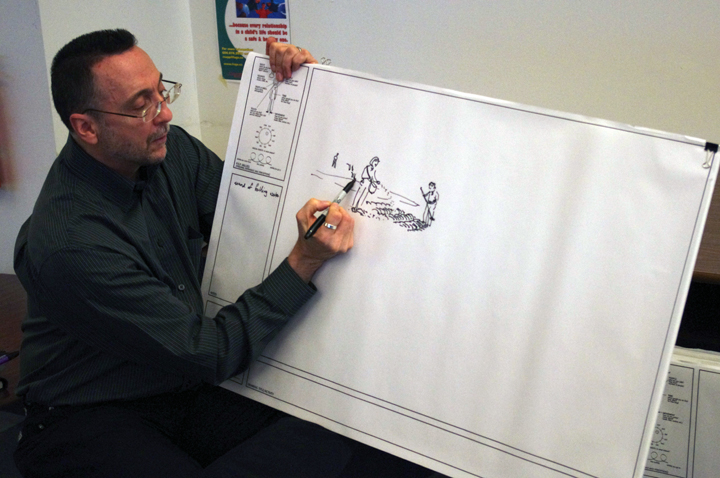
Stanley is facilitating a drawing with youth participants
Susan invites participants to create a city on the wall
participants create a city out of wilderness
Desired personal experience and perceptions noted on this drawing
Day in the Life of the Garden, a graffiti wall.
Susan draws youth harvesting mushrooms on a cob house, at the direction of the participants
Drew Ferrari facilitating a collaborative design dialogue. This sequence of drawings took less than an hour. activities and features are dictated precisely by participants.
the collaborative drawing is now complete and features are numbered for voting
If youth designed a city, what would it look like? More importantly, what would it be like to live there? Would they create places very different from our cities today? Our work with Vancouver youth reveals that a youth designed city would be green, full of light and life. Skateboarding, cycling and blading would be the wheels that rule the roads. Places for dancing, art, music, gathering, sports, napping would dot the urban landscape. School would take place outdoors. Youth have fresh eyes, new perspectives that are unencumbered by thoughts of mortgages and economics and politics (King, 1995). Paul Goodman said "No city is governable unless it grows citizens who feel it to be theirs".