Forty years ago, Stanley facilitated the community engagement for many neighbourhoods in Vancouver. Two of these places were formerly devoted to cars: Robson Square used to be a huge parking lot, and False Creek was a "car graveyard". His data revealed that ordinary citizens preferred to turn these areas into car-free spaces. Daphne Bramham interviews Stanley in the Vancouver Sun:
"It’s hard to believe that not that long ago serious consideration was given to filling in False Creek and paving it over with homes and roads. Architect Stanley King was among the first to challenge that idea and to imagine a residential community with a public market as its centrepiece built along the creek’s south shore on derelict industrial land..."Read more: False Creek South: It's near perfect, and it's mine - Vancouver Sun article by Daphne Branham

Showing posts with label cities. Show all posts
Showing posts with label cities. Show all posts
Saturday, September 17, 2011
Wednesday, July 20, 2011
Co-design Demo at the Viva Vancouver Street Party
There will be Brazilian martial arts, dance food and... co-design! Click on the image below to get the schedule. photos of event here.


Tuesday, May 10, 2011
crowdsourcing

I attended the lecture on Crowdsourced Cities conducted by SFU. Lukas Biewald of Crowdflower explained the background and trends in crowdsourcing, Darin Dinsmore of Crowdbrite showed how an international competition led to innovation in design., and Colleen Hardwick of PlaceSpeak demonstrated the use of pioneering software for location-based community consultation.
Each speaker spoke of their innovative use of the computer to reach people to collect many human judgements on planning issue. The large numbers of opinions, and the speedy gathering of them, were seen as advantages over traditional methods of public design dialogue.
Monday, April 25, 2011
Plan-It Earth, planned by youth for youth

We are very grateful for support from Bruce Ford and Vanessa Lee (Metro Vancouver); from Amanda Mitchell (the City of Vancouver); from Kevin Millsip, (sustainability coordinator, VSB) and Stanley King from the Co-Design Group who donated facilitation services. We accepted funding, with thanks from Architecture Canada: The Royal Architectural Institute of Canada, the Vancouver Foundation Youth Philanthropy Council, and the Vancouver School Board through Kevin Millsip's project eco-logo contest.
 |
| Tesicca, youth co-design artist, plan-it earth core team |
 | ||
day in the life of a sustainable region
 |

Monday, March 21, 2011
thoughts on David Owen's Lecture: Why Manhattan is the Greenest City in North America

Co-design attended David Owen's lecture in Vancouver. A summary of Owen's ideas can be found in his blog here, and in the New Yorker article here. Owen argues that dense urban centres are an effective alternative to sprawl for preserving farmland and ecological habitats. And "living smaller, closer, driving less" reduces our carbon footprint. While this is true, I'm not convinced that density on the scale of NYC is a green solution.

If high-density urban centres preserve earth's wilderness and farmland by virtue of avoidance, then this solution might be even more green than NYC:
 |
| Moon base Alpha |

Density is an efficient solution but is it ecological? Ecological systems are self supporting. Take into consideration the following factors: living plants and animals forming the food source, waste absorbed by the landscape; inhabitant's psychological need for light and green space... If we now draw a radius from NYC , what would be the extent of the circle?
Monday, March 14, 2011
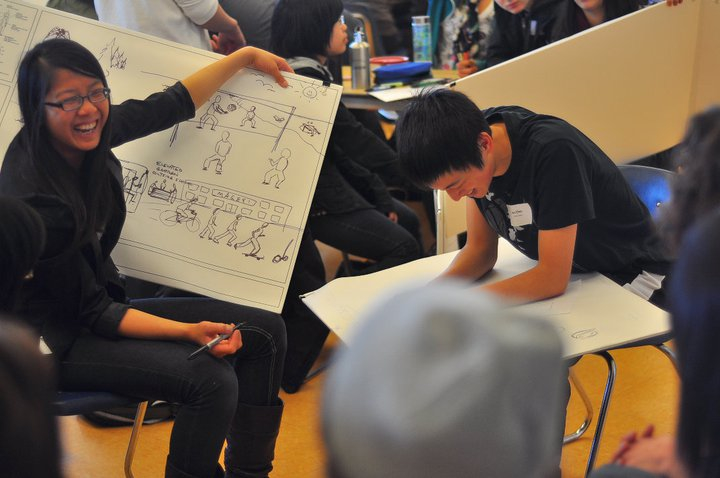
Training youth co-design artists for Plan-it Earth

Youth from five different Vancouver Schools are training to be co-design artists for the Plan-it Earth conference on April 15th. Planned by youth, for youth, registration started last week. Today's training session was at Granville Island. They learned: how to draw people in a one and two point perspective; marker techniques on vellum paper; and how to draw foliage quickly. First steps in learning co-design dialogue techniques from Stanley King.
 |
| Stanley knows the art of gentle crit |
Friday, February 18, 2011
youth led planning conference for our sustainable region
Plan-it Earth 2011: Vancouver youth from Prince of Wales Secondary, Churchill, Kits, St. Pats are organizing this youth conference again to draw describe, film their sustainable region and present it to city planners. it will be similar to Plan-it Earth 2010. The co-design drawings from Plan-it Earth 2010 were displayed at last fall's Talk Green To Us public event at Woodwards.

Monday, February 14, 2011
UBC SCARP community engagement and "neighbourliness"
This video summarizes a design event focused on co-designing the future of the Britannia Centre. Facilitated by Maged Sembel's classes from UBC's School of Community and Regional Planning. In part, it features the co-design work of Stanley King.
Note the richness of citizen ideas as partcipants express a desire for an integrated neighbourhood of diversity, creativity, and affordable living. Co-design images emerge showing pedestrian spaces for every age group, and activities relating to art, food security and community.
At the end of the video, a cameo of Ray Spaxman, former director of planning for the City of Vancouver, and a champion of "neighbourliness":
-- Gordon Price, "It Takes One Icon to Know Another", Vancouver Sun, Web.
.
At the end of the video, a cameo of Ray Spaxman, former director of planning for the City of Vancouver, and a champion of "neighbourliness":
"Ray Spaxman was recruited as city planner by Vancouver's leadership in 1973, when the public was in full flight from the excesses of modernism and out-of-control development. Only a decade and a half previously, the tallest building in the West End was the Sylvia Hotel. ("Dine in the Sky" said the sign on the roof.) And not many people thought several hundred concrete slabs had really improved our urban ambience all that much.
Spaxman was responsible for changing the way planning and development was done in this city -- and he summed it up in one word: "neighbourliness." A building had to be respectful of its neighbours, and of the citizens on the street.
Buildings, in other words, had to be more than sculptural objects on vacant plazas -- "pigs in space," as some planners call them. It didn't matter how "iconic" a building was if it selfishly ignored the urban environment in which it dwelt."
Spaxman was responsible for changing the way planning and development was done in this city -- and he summed it up in one word: "neighbourliness." A building had to be respectful of its neighbours, and of the citizens on the street.
Buildings, in other words, had to be more than sculptural objects on vacant plazas -- "pigs in space," as some planners call them. It didn't matter how "iconic" a building was if it selfishly ignored the urban environment in which it dwelt."
.
Sunday, January 30, 2011
The Urban Tsunami


The design solution lies not in buildings, energy efficient cars, gadgets, but the redesign and re-imagining of a life.
Tuesday, January 25, 2011
Jan Gehl Lecture

Stanley attended the Jan Gehl lecture and found a great connection to co-design.
His theme was the long lack of human scale and life in the architectural and planning design processes, how architects since the 60’s have been anti-people (as a newly graduated architect he had to change because his girl friend, later his wife, was a psychologist and asked him, “Why do architects hate people?”) Planners, he said, have for years been sweet on the car and now must be sweet on people, and particularly, sweet on cyclists.
He said they now have a problem of bicycle congestion in Copenhagen and must push bike-lanes into more car-lanes. Research shows that for every kilometre bicycled the city gains 25c, and for every kilometre car travelled the city loses 10c. And when New York Times Square went pedestrian the merchants around increased turn-over by 71%. Great stuff.
- Stan
See a video of Jan Gehl here: select the photo below:

Subscribe to:
Posts (Atom)