Forty years ago, Stanley facilitated the community engagement for many neighbourhoods in Vancouver. Two of these places were formerly devoted to cars: Robson Square used to be a huge parking lot, and False Creek was a "car graveyard". His data revealed that ordinary citizens preferred to turn these areas into car-free spaces. Daphne Bramham interviews Stanley in the Vancouver Sun:
"It’s hard to believe that not that long ago serious consideration was given to filling in False Creek and paving it over with homes and roads. Architect Stanley King was among the first to challenge that idea and to imagine a residential community with a public market as its centrepiece built along the creek’s south shore on derelict industrial land..."Read more: False Creek South: It's near perfect, and it's mine - Vancouver Sun article by Daphne Branham

Showing posts with label planning. Show all posts
Showing posts with label planning. Show all posts
Saturday, September 17, 2011
Sunday, August 21, 2011
Biodiverse-City at the Beaty Museum


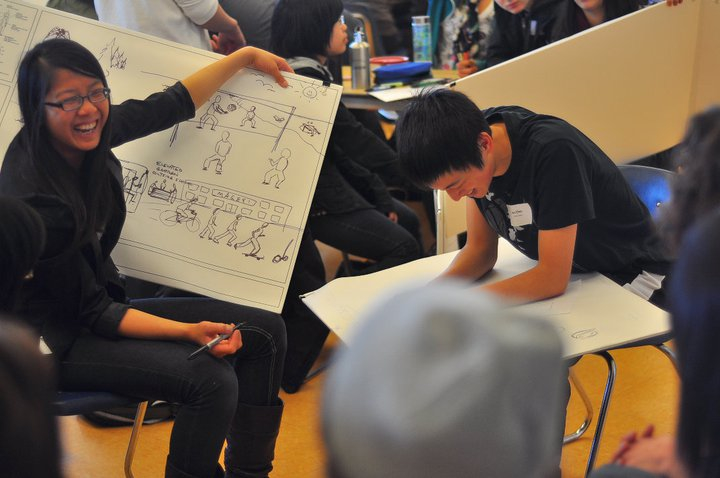
Beaty Biodiversity Museum had their Urban Festival today. Their flagship specimen is an enormous blue whale skeleton. Imagine your city respects biodiversity. What would you be doing? Families, teens, toddlers, and fellow Beaty volunteers co-designed "biodiverse-city". Two 17 year old visitors from Ontario expressed great concern for their ecological future. They were interested in biology, ecology and art. One drew a mermaid on the "Day in the Life" timeline. The conversation made me reflect on how a combination of passion, leadership, creativity and technical expertise will be required of youth to face challenges they never chose for themselves. They were fascinated by the museum, biodiversity and the challenge of designing a biodiverse-city.


Wednesday, July 20, 2011
Co-design Demo at the Viva Vancouver Street Party
There will be Brazilian martial arts, dance food and... co-design! Click on the image below to get the schedule. photos of event here.
Thursday, June 23, 2011
Early work, 1970s
Some photos of early co-design work pioneered by Stanley King. In this case, the site was a huge parking lot in downtown Vancouver. Stanley organized a "City on the Wall" and also a "Design- in". During the site walk, teens analyzed the car lot for sight, smell, sound, movement and circulation. The resulting drawings illustrated public desire for activities supported by abundant green space, a dome with a skating rink, outdoor eating, water features.
People asked for car-free pedestrian spaces for relaxing, socializing, eating. The ideas, drawn from ordinary citizens, demonstrate how co-design can sensitively tap into citizen's desires for how they wish to live. Drawings were given to the design team led by Arthur Erickson who designed Robson Square. Erickson asked Cornelia Oberlander to design the landscape: the first roof garden in North America.
These still shots are from Chairs for Lovers, a documentary film directed by Barrie Howells for the National Film Board of Canada.
 |
| Robson Square Before |
 | ||||
Robson Square (after) designed by Arthur Erickson
|


 |
| Stanley King starting the "city on the wall": "imagine you were here when the land was new...." |
 |
| Stanley encourages kids to draw anything they want in a city |
Tuesday, May 10, 2011
crowdsourcing

I attended the lecture on Crowdsourced Cities conducted by SFU. Lukas Biewald of Crowdflower explained the background and trends in crowdsourcing, Darin Dinsmore of Crowdbrite showed how an international competition led to innovation in design., and Colleen Hardwick of PlaceSpeak demonstrated the use of pioneering software for location-based community consultation.
Each speaker spoke of their innovative use of the computer to reach people to collect many human judgements on planning issue. The large numbers of opinions, and the speedy gathering of them, were seen as advantages over traditional methods of public design dialogue.
Monday, April 25, 2011
Plan-It Earth, planned by youth for youth

We are very grateful for support from Bruce Ford and Vanessa Lee (Metro Vancouver); from Amanda Mitchell (the City of Vancouver); from Kevin Millsip, (sustainability coordinator, VSB) and Stanley King from the Co-Design Group who donated facilitation services. We accepted funding, with thanks from Architecture Canada: The Royal Architectural Institute of Canada, the Vancouver Foundation Youth Philanthropy Council, and the Vancouver School Board through Kevin Millsip's project eco-logo contest.
 |
| Tesicca, youth co-design artist, plan-it earth core team |
 | ||
day in the life of a sustainable region
 |


Bridging the generation Gap
North shore news featured youth co-design in West Vancouver:
"Through outreach, the co-design process adopted by Grosvenor attempts to bring in voices from different demographics, says Michael Mortensen, Grosvenor Americas’s senior development manager. It’s a unique opportunity for youth to be involved in a process that usually takes place among adults. Co-design forums were pioneered by Vancouver architect Stanley King, who is leading the Ambleside forums. He created the concept while working on Granville Island and Robson Square.
"Through outreach, the co-design process adopted by Grosvenor attempts to bring in voices from different demographics, says Michael Mortensen, Grosvenor Americas’s senior development manager. It’s a unique opportunity for youth to be involved in a process that usually takes place among adults. Co-design forums were pioneered by Vancouver architect Stanley King, who is leading the Ambleside forums. He created the concept while working on Granville Island and Robson Square.
In the end, the youths’ ideas became a big part of Vancouver’s identity. It was their suggestion to place a skating rink in Robson Square; famous West Vancouver architect Arthur Erickson was inspired by their sketches filled with greenery when designing the provincial courts."
Full article here: "Bridging the Generation Gap" by Rebecca Aldrous, North Shore outook
Monday, February 14, 2011
UBC SCARP community engagement and "neighbourliness"
This video summarizes a design event focused on co-designing the future of the Britannia Centre. Facilitated by Maged Sembel's classes from UBC's School of Community and Regional Planning. In part, it features the co-design work of Stanley King.
Note the richness of citizen ideas as partcipants express a desire for an integrated neighbourhood of diversity, creativity, and affordable living. Co-design images emerge showing pedestrian spaces for every age group, and activities relating to art, food security and community.
At the end of the video, a cameo of Ray Spaxman, former director of planning for the City of Vancouver, and a champion of "neighbourliness":
-- Gordon Price, "It Takes One Icon to Know Another", Vancouver Sun, Web.
.
At the end of the video, a cameo of Ray Spaxman, former director of planning for the City of Vancouver, and a champion of "neighbourliness":
"Ray Spaxman was recruited as city planner by Vancouver's leadership in 1973, when the public was in full flight from the excesses of modernism and out-of-control development. Only a decade and a half previously, the tallest building in the West End was the Sylvia Hotel. ("Dine in the Sky" said the sign on the roof.) And not many people thought several hundred concrete slabs had really improved our urban ambience all that much.
Spaxman was responsible for changing the way planning and development was done in this city -- and he summed it up in one word: "neighbourliness." A building had to be respectful of its neighbours, and of the citizens on the street.
Buildings, in other words, had to be more than sculptural objects on vacant plazas -- "pigs in space," as some planners call them. It didn't matter how "iconic" a building was if it selfishly ignored the urban environment in which it dwelt."
Spaxman was responsible for changing the way planning and development was done in this city -- and he summed it up in one word: "neighbourliness." A building had to be respectful of its neighbours, and of the citizens on the street.
Buildings, in other words, had to be more than sculptural objects on vacant plazas -- "pigs in space," as some planners call them. It didn't matter how "iconic" a building was if it selfishly ignored the urban environment in which it dwelt."
.
Subscribe to:
Posts (Atom)